2020 Corporate Investment Outlook


Heading into 2020, many companies are sitting on large amounts of cash to invest. They’ve been investing in share buybacks, which has the potential to artificially boost share prices. This can explain why the markets continue to break record highs despite earnings growth slowing down. Share buybacks have been such a widely used tool that companies are even taking out debt in order to invest in their own shares. Given the global uncertainties that are beginning to clear up, I suggest that companies look more towards long-term investments through attractive M&A deals as well as putting cash towards R&D and their operations. In this post, I will elaborate on the impact of share buybacks and explain why I see M&A as a better strategy for free cash flow allocation in the new year.

With an emphasis on liquidity and with corporate cash stockpiles growing under the Fed’s “easy money” policies, companies are putting their cash towards buying back their own shares. In a share buyback, a company buys its shares to decrease the number of shares outstanding, therefore decreasing its capital structure’s proportion of equity to debt. This has an effect on a company’s EPS (earning per share) and can explain why so many companies beat their EPS expectations despite a slowdown in earnings growth. According to an article in the Wall Street Journal, “Companies on the S&P 500 have poured more than $5.3 trillion into repurchasing their own shares since 2010” (WSJ). This number helps explain why the market has been thriving despite looming macro uncertainty. Along with the EPS boost, stock prices have already priced in earnings growth for the coming year which will help keep the market trending upwards (Barron’s).

Share buybacks are a way for companies to give back to their shareholders by helping to increase the share price. However, given the context of the market in the past year, it seems as though buybacks are a defensive measure taken against uncertainty. It is difficult for companies to make large and risky investments when the future is tough to forecast. As confidence grows and uncertainty continues to clear up, companies should be investing their free cash flow holdings into capital expenditures, R&D, and M&A activity (especially with share prices so high, companies can implement stock deals as a way to fund their transactions). M&A transactions help companies add value to their business in an attempt to gain a competitive advantage by increasing in scale, expanding, and eliminating competitors.

Volume and Value of M&A transactions worldwide

Long-term sustainability is important when it comes to the strategies that companies decide to implement in 2020 because they are being held more accountable through the increase in activist investors. Activist investors have played a big role in influencing a company’s organizational structure and the way in which it invest its resources. This is a proponent that will continue to drive trends in capital allocation and strategy. With these activists keeping a close eye on corporate behavior, companies will have to move away from short-term investments and decision making, which could suggest that buybacks won’t be as popular. This means that companies should look to pursue M&A strategies, specifically focusing on their core competencies in order to increase the size and quality of their operations instead of diversifying into industries that don’t necessarily make sense for that business. M&A transactions that veer too far from a company’s business model could serve to create a complex conglomerate that would be exposed to risks that would have otherwise been avoided. Especially with regulatory reform in mind and the increased scrutiny on mega-corporations, companies should use M&A as a means of strengthening what they do best.

As 2020 begins, the concerns investors face should begin to resolve. Brexit was one of the biggest factors standing in the way of long-term investment, especially in England. With the process seeming to come towards its eventual conclusion, confidence will be restored. The phase one deal between the US and China will also boost sentiment by promoting international trade and engagement. It is yet to be seen what the tensions in Iran will culminate to, but 2020 does look to be more encouraging for investors looking to take on more risk. On a corporate level, this means engaging in more frequent M&A transactions (as in more volume instead of being driven by mega-deals) while putting money into growth through PPE (property, plant, and equipment) and other R&D projects. Share buybacks will continue to be a widely used tool, especially during earnings season, but given the outlook for the upcoming year, it should not be the first place companies look to invest their free cash flow in.

– S.F

References


WeWork and Saudi Aramco: IPOs from a Behavioral Finance Perspective


In a previous post I made, I used WeWork and Saudi Aramco as two examples to show how Behavioral Finance can help financiers understand the psychology behind things like IPO’s. Both of these companies and their respective IPO processes merit a deeper look from the perspective of Behavioral Finance as there are many more concepts prevalent than simply just the Endowment Effect. Keeping in mind that Behavioral Finance assumes that people are predictably irrational, these well-documented stories can be further broken down.

WeWork

The case of WeWork has been one of the most dramatic collapses we have seen in recent times on Wall Street. Although it is certainly not the end for WeWork, the company and SoftBank have a lot to do. The IPO fiasco has hurt their public image and raised plenty of questions on the sustainability of their business model as well as how they can even begin to turn a profit.

Where did it all go wrong for the once promising company that was initially valued at $40 billion? Typically a company should pursue an IPO because they have a profitable business model, strong fundamentals, and they want to raise capital to push their growth even further, while also accepting the responsibilities to shareholders as a publicly traded company. In recent times however, companies that are yet to profit or that don’t even have a path to profitability (Uber for example) have been the hottest IPO’s, essentially selling shareholders on untapped potential and the opportunity to invest early in what could be a company of the future. That is the responsibility that private equity funds and venture capital firms should take on, not the average investor in the stock market. These companies clearly still need the guidance and time provided as a private company before they even consider selling their shares to the public.

Throughout the process, a big component of what misled investors was how WeWork and their numbers were framed. This office leasing company was labeled by themselves and the bankers promoting their shares as a “tech” company. In reality, there was not much tech involved in what WeWork actually does. The reason they would want to push themselves as a tech company is in part because of how successful tech stocks have performed, especially in 2019. Tech stocks have dominated, reaching new highs almost every month at this point and pushing up their respective indexes. WeWork likely wanted to ride the tail of the “tech” label in an effort to keep up with the high flying sectors’ returns. We have now come to learn that WeWork also framed their accounting numbers in violation to GAAP standards (specifically contribution margin among others) which was flagged by the SEC. They touted this miscalculated metric all over their revised prospectus. Originally labeled as “Community Adjusted EBITDA”, it turned an actual 2018 net loss of $1.9 billion into a $467 million profit. This behavior is extremely misleading to potential investors who may have seen the potential in WeWork when framed in this light. Instead, they ran the numbers and saw themselves that it did not make sense, ultimately leading to the company scrapping its IPO. Framing is a powerful tool that was used to mislead investors in this case by trying to make WeWork out to be something they were not.

The initial $40 billion valuation of the company served to play into a heuristic called Anchoring Bias. It is similar to behavior exhibited in contract negotiations for example where one party may give an initial offer 50% higher than what they expect so that negotiations will be anchored around that given price. Despite having their initial valuation torn apart, this is exactly what they attempted to do by giving such a high number to begin promoting shares at. The last thing they expected was to have that number fall $8 billion and lower today as financiers try to determine the company’s true worth.

In my previous post about Behavioral Finance, I briefly mentioned the role that the Endowment Effect played in this IPO process. To be more specific, the key players that exhibited the Endowment Effect as this played out were SoftBank and Adam Neumann. SoftBank, known for investing in potential tech unicorns, and Adam Neumann, WeWork’s eccentric CEO, both held this company at a much higher valuation because of the time, money, and responsibility they had to the company. This attachment and association to WeWork led them to a skewed price at which investors actually wanted to buy shares for. The good thing about roadshows is that they will put these valuations to the test and in most cases will lead to a more realistic valuation if the company is even ready to IPO at all. By understanding that private investors and CEOs are influenced by the Endowment Effect, bankers can put focus towards better explaining the shortcomings of a potential IPO and guiding company leaders to setting a price more realistic from a public investors’ point of view.

At this point having held WeWork for too long, SoftBank is dealing with Loss Aversion. Instead of of loading the wreck caused by the scrapped IPO, they must now work to turn things around in an attempt to gain some sort of return on their investment in the company. SoftBank still holds their position in WeWork so it is yet to be seen whether or not they can restructure and reform it into the company it was supposed to be before the IPO process revealed the reality of the situation.

Saudi Aramco

When it comes to the oil giant that is Saudi Aramco, there are a lot of behavioral factors that play into their IPO as well as the company itself. It is a unique case and different in many aspects to WeWork primarily because it is a government controlled entity. This means that Saudi Arabia have had a big influence throughout the entire process of taking the company public.

Like WeWork, the IPO played into the Endowment Effect as well as Anchoring Bias. This explains the initial valuation they gave themselves of $2 trillion while also being attached to the idea of having the biggest IPO in history. Anchored at such a high price tag, it was difficult to talk Aramco down to a price that would be more appealing, especially to foreign investors who had a number of doubts surrounding the company. The bankers working on the deal had a hard time justifying the number, especially considering the value of comparable companies such as Exxon and Chevron. Being that it is a nationally held company, the government is only selling a 1.5% stake. This shows how hard it is for them to let go of a bigger percentage of a company that is seen as a crucial component of what Saudi Arabia is today. Buying shares of Aramco, as a result, gives investors very little influence because of the control and equity that the government will maintain. Investing a company’s shares are meant to grant some form of ownership to buyers, but in this case there is very little ownership even being offered in Aramco.

Not willing to budge, Aramco decided on a local listing and hired a new team of bankers. This move was a display of Confirmation Bias, where someone may seek information that supports their claims while rejecting anything that goes against them. The new bankers were willing to play up to their high expectations and essentially saved the IPO from being scrapped. By opting for a local listing and foregoing international roadshows, Aramco sought confirmation through domestic markets and investors. They even offered loans and bonus share opportunities for locals so that they could invest into the IPO, making it likely that early investors hold onto their positions for the long term.

This leads into the final heuristic that was in effect; Familiarity Bias. Saudi Aramco, an oil behemoth and the biggest source of exports for the country, is held as a symbol of national pride for Saudi Arabians. As a result, local investors are all in on Aramco. Familiarity Bias in this case is when investors put their money and interests into something they know very well and recognize. Aramco clearly understands this, which is why they decided on the local listing while granting locals the opportunity to heavily invest into the IPO. This gives some room to push up the price as they attempt to reach and surpass the $2 trillion mark.

Having gone public at $1.7 trillion, it remains to be seen whether the company and government were justified in demanding such a high price tag or whether the price will meet a harsh reality. They were able to go public at a price they were comfortable at while also avoiding the scrutiny they may have faced at foreign roadshows. Given the biases and behavioral concepts that they used to push their IPO, it is likely that the stock will rise for a while as locals power the price upwards. It will be interesting to see how things turn out once they decide on a foreign listing and begin promoting shares to investors outside of the Middle East.

In Conclusion…

IPOs signal a big change for a company, going from privately held to public. For the owners and founders, this means giving up a stake in the company they helped build. For bankers, this is the opportunity to raise capital for the technologies and services that push our society forward. For investors, it is the chance to own a piece and have influence over the companies that drive our economy. It is thus crucial all around that the parties involved understand what to look out for in terms of the patterns that humans behave predictably irrational in. WeWork and Saudi Aramco are two recent examples that clearly show the things that can go wrong in an IPO as well as the influence that some parties have over determining its success.

References


Financial Calculator VB.Net Application


For the past few weeks, I have been migrating my initial stock/options calculator from excel to a full VB.Net project. This has been a challenging, but very rewarding experience because of how gratifying it is to use the skills I have learned at work towards building a financial program of my own. It is built on a Calculator UI with a Financial Library I created that houses all of the stock and option functions necessary to run the program. It is fascinating to see everything come together and how easy a particular process can be made by writing it in code.

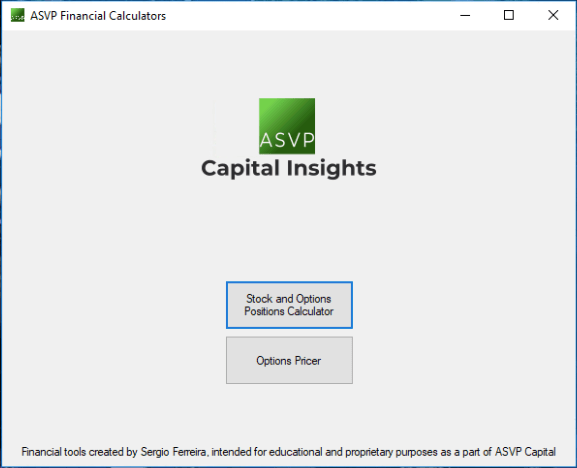
Startup Menu

Not only did I want the calculator to run well, but it was also important to me that I take the time to give it a professional design so I added my logo along with other elements to help it stand out. As I get more comfortable designing in windows forms, I will improve the look of the program to make it more modern-looking. The image above is the startup menu where users can select to open either the “Stock and Options Positions Calculator” or the “Options Pricer”.

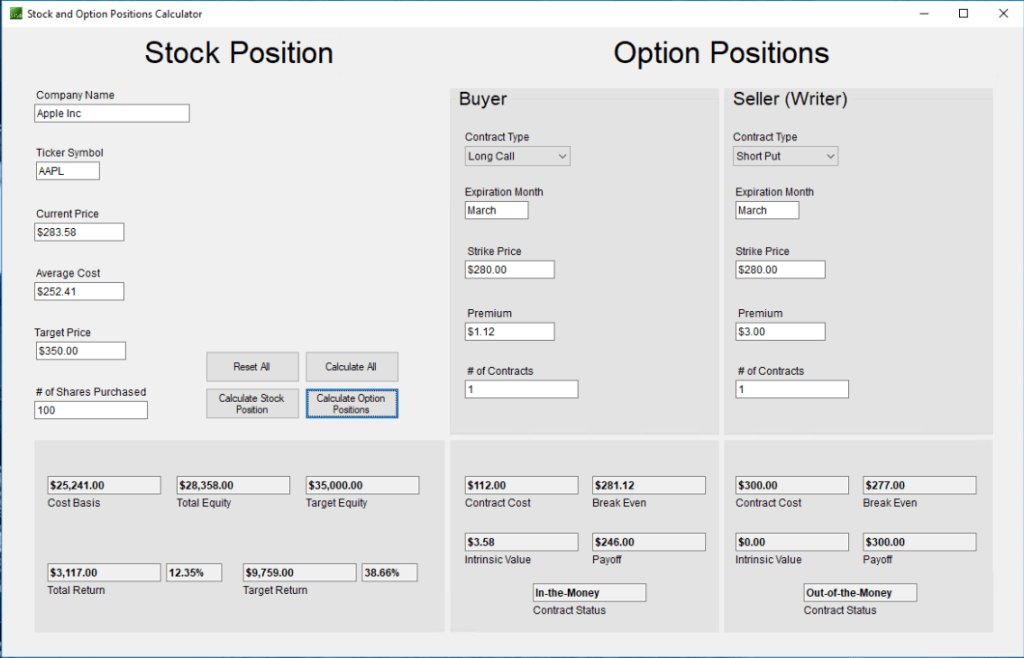
Stock and Options Positions Calculator

Opening the “Stock and Options Positions Calculator” opens the form above which includes all the functionality from my original Stock/Options Calculator on excel. I used Apple as an example in the picture above to show the accuracy of the calculations and the information it can provide on the options side of things. The most challenging part at first was figuring out how to properly format the text boxes as percents and currencies. Once I finally learned how to do that following an extensive internet search, everything else came quickly since it was the finance logic that I have been familiar with.

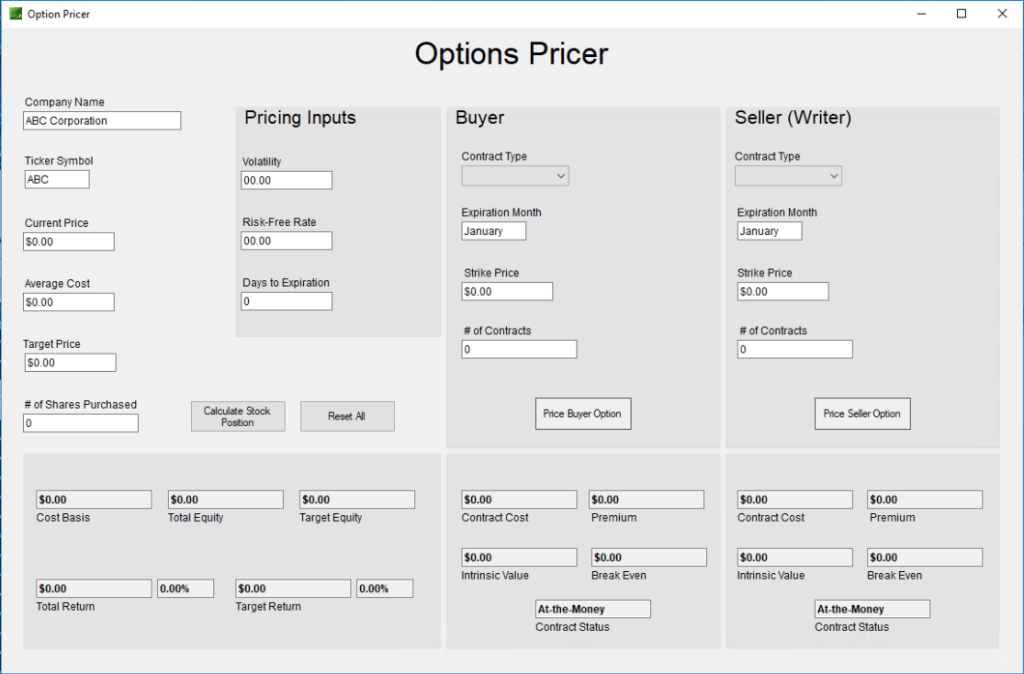
Options Pricer

The “Options Pricer” is a work in progress as I still have to properly translate the math involved in calculating option premiums into code. It needs a bit of tweaking, but the principal logic is there. The idea is to be able to calculate a particular option premium based on the specified volatility, risk-free rate, and days to expiration along with the other necessary fields (Contract type, Strike, # of contracts). This particular calculator has stretched me outside of my comfort zone when it comes to complex math, which has helped me become more adept with numbers. As the formulas continue to click, I feel more comfortable working with the more complicated financial concepts like Black-Scholes models among others.

This is a project I would love to share on my blog, but I am not sure how to properly upload it yet. Getting users to test the application themselves is the best way to get feedback on it so that I can continue improving it. Once I figure out how to share it, I will post it here. Working on this project has given me the idea to develop other tools such as a WACC calculator and other portfolio management resources. I am excited to continue sharing my work and journey!

-S.F.


Jane Street Puzzles – Hooks #5


Recently, I’ve come across Jane Street’s archive of puzzles; ranging from riddles, math, chess, and other quantitative problems. These have been challenging to say the least, but a lot of fun to figure out. Jane Street is a proprietary trading firm that engages in market making and arbitrage. I figured that these puzzles would give me a good idea as to how the minds at Jane Street think when they are problem solving and developing solutions for their business.

After searching the archives, I found a puzzle from June 2019 that I felt would be interesting to try to figure out. Titled “Hooks #5”, it is a math and numbers based puzzle. I’ve attached the prompt in the picture below…

Prompt for Jane Street’s “Hooks #5” puzzle

Although it was tough to grasp the rules after reading it the first time, I broke it down to make it easier for myself. Essentially, there are 9 sets of hooks starting with a 9 block hook going down all the way to 1 that must be strategically placed to complete the 9×9 box grid. Squares that are part of the hook must be “orthogonally adjacent”, which just means that the sides have to touch. Along the outside of the box grid there are numbers which are meant to indicate the sum of the first set of consecutive blocks looking from that direction’s perspective as a tool to get you started. After the grid is filled, the answer can be found by finding the product of the area of the empty grids (multiplying the groups of connected empty grids with each other). Once I understood the rules, I felt confident enough to get started.

My solution to “Hooks #5”

It has become a habit of mine to use excel for almost everything because I see it as a basic programming language that has a lot of different tools and resources that make working with numbers more efficient. Being that this was a grid-based puzzle, it only made sense for me to use excel. After setting up the grid like how it was displayed on the prompt, I began filling in the squares, using the numbers on the outside as a guide. There were a lot of different combinations that would add up to make the outside numbers, so it was a lot of trial-and-error, but also logical. The first few sets of hooks, from 9 to 7, came to me quick. The deeper I got within the grid however, the more I had to experiment with number combinations, but they made sense keeping in mind that they had to be orthogonally adjacent.

Excel function i used to solve for the product of the area of the connected empty regions

By color coding each set of hooks, I was able to follow my work easier than if I were to have done it on paper. This also allowed me to place 1’s in all of the empty regions so that once the grid was filled, I could simply get the sum of each region and multiply them together (as shown in the screenshot above). I found that by using this method, I could get the most accurate answer and avoid any miscounting or math errors. This gave my answer to the puzzle, which was 78125.

It took me about a weekend’s worth of analyzing and working on the puzzle to get to my answer. What I enjoy most about these puzzles are that they really make you sit there and think critically. You have to break them down before you even start your attempt, and that challenge is what makes it fulfilling once you finish. It builds good habits that can carry over into any type of problem solving scenario outside of these puzzles. I’ll keep my eyes out for new puzzles while I try to work out some of the older ones. I’ve added a link to Jane Street’s puzzle page for anyone who want to try them as well (https://www.janestreet.com/puzzles/archive/).

-S.F.


Behavioral Finance


In my final semester at Seton Hall, I enrolled in a relatively new course that focused on Behavioral Finance. I figured it would give me an interesting perspective by drawing connections to psychology and the markets. The course did so much more than just that. It became apparent to me that the concepts that define Behavioral Finance can be pointed out in everyday life, and that the more you learn the more you begin to see it. What also made the course fascinating to me was the fact that we were taught how to read and interpret research papers. Although they may initially seem like they’re written in an entirely different language and are tedious to get through, breaking them down and getting used to the style that they’re written in makes all the difference in taking something away from these readings.

The whole world of Behavioral Finance is a pretty recent idea that has begun gaining credibility because of the way it makes us rethink the way we look at economics/finance. Centuries of neo-classical economics have been built on the premise that people act rationally, but Behavioral Finance argues against that notion. Instead, it assumes that people are predictably irrational. This is the point that Amos Tversky and Daniel Kahneman, who are often credited as the pioneers of Behavioral Finance/Economics, describe in their paper, “Prospect Theory: An Analysis of Decision Under Risk”(which can be found here: https://www.jstor.org/stable/1914185?seq=1). They found that people tend to exhibit risk-averse behavior when confronted with gains and that they tend to be risk-seeking when confronted with losses.

The rest of this post will describe 3 particular concepts that make up what Behavioral Finance is. It will include research papers and experiments, and I will relate it all to how it affects the broader market.

Loss Aversion

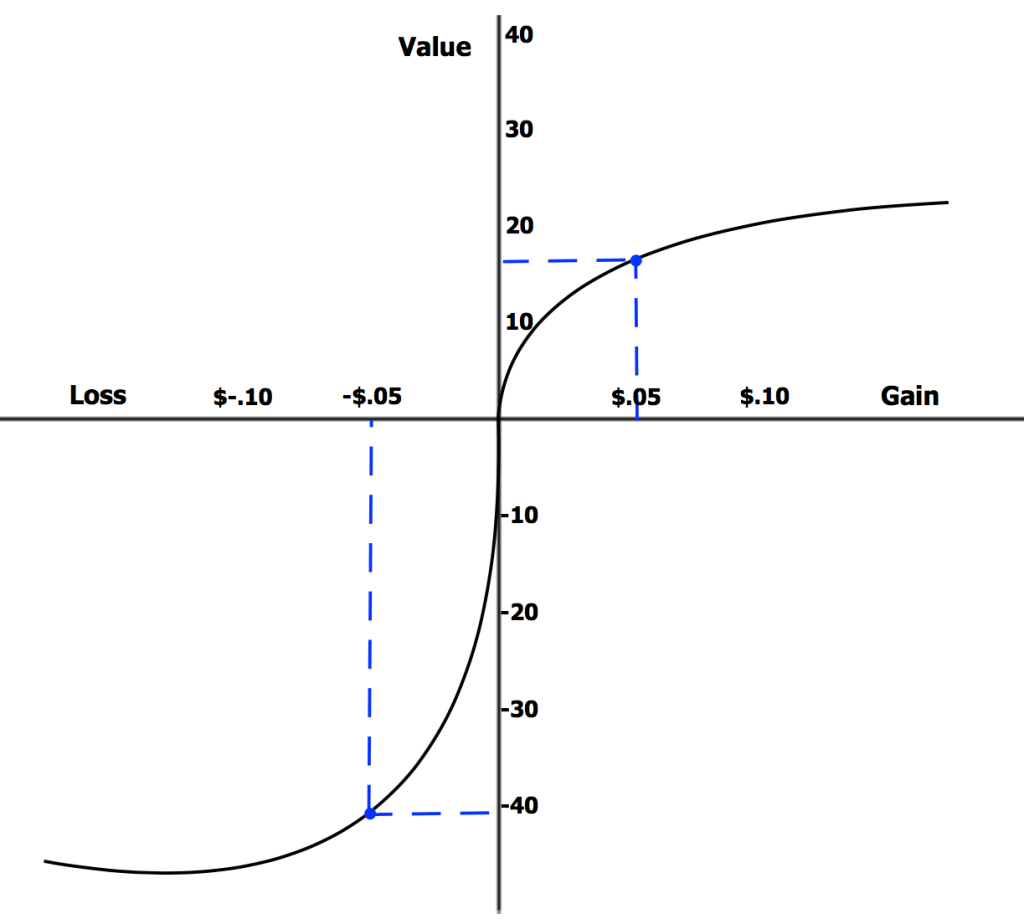
Kahneman and Tversky’s Prospect Theory is based on reference dependence, diminishing sensitivity, probability weighting, and loss aversion. Loss aversion describes how people prefer avoiding losses to acquiring equivalent gains. Essentially, losses feel more than twice as bad as a gain would. In a real-world context, this would be like turning down a full-ride to a top tier university across the country because you don’t want to move away from your family. In that case, you become loss averse to the people you grew up with as that loss would affect you more than gaining an education across the country. There are countless real-world examples of this behavior that you can point out as you go about your day.

The chart above shows graphically how much more value losses have over equivalent gains.

From a market perspective, loss aversion can be exhibited when someone sells a stock at a slight gain because they rather take their returns instead of risking the loss of their initial investment. The stock could have gone up higher based on valuation and metrics, but a realized gain of any amount feels much better than a loss. Another example would be holding on to an unrealized gain hoping it will turn into a profit instead of cutting your losses. Loss aversion is a tool that financial advisors, portfolio managers, and bankers can use to understand and mitigate the risks of their investments. It gives them a psychological reason behind the irrationality of how people can behave.

Framing

I find framing to be one of the most interesting concepts because of how prevalent it is. It’s a tool that is used by the media, marketing teams, politicians, sales, and finance among other things. Framing is a cognitive bias that describes the effect presentation has on decision making. This means that people decide on options based on presentation, perception of what the question is trying to say, and personal characteristics. For example, imagine you are presented with 2 choices of meat. One is presented as being 5% fat, and the other 95% lean. Most people are likely to choose the 95% lean meat based on how the choice is framed, despite them being the same thing.

Yoav Ganzach and Nili Karsahi’s paper, “Message Framing and Buying Behavior: A Field Experiment” (which can be found here: http://citeseerx.ist.psu.edu/viewdoc/download?doi=10.1.1.317.9267&rep=rep1&type=pdf), puts framing to the test. In the paper, they experimented with loss aversion by partnering with a credit card company. The test consisted of contacting customers who did not use their card for a 3 month period. These customers would receive a communication that either explained what there was to gain from using their card or what would be lost as a result of not using the card. This experiment is in line with the assumptions of both Prospect Theory and Loss Aversion. To sum it up, the results showed that those customers who received the loss-framed communication got twice the credit card utilization and charges compared to those who received the gain-framed message. This experiment shows that when facing a loss, people are more likely to take action and feel the impact of a particular message.

While framing something as a gain may seem to point out enough positives to persuade someone, it is not nearly as strong as framing something as a loss. An M&A banker would be able to use loss aversion and framing to more effectively close deals by emphasizing to clients what they will lose as a result of falling through on a merger. You see it all the time in advertisements, where if you don’t get the latest upgrade or tech, you are falling behind the pack instead of actually gaining something resourceful out of it. It’s this type of power that makes framing one of the most widely used and exhibited cognitive biases.

Endowment Effect

The great part about learning endowment effect in class is that we were unsuspectedly involved in an experiment to prove it ourselves. We participated in a raffle for 7 Behavioral Finance cups. The next week, those who received a cup were asked to put a price on how much they’d sell it for while those who did not get one (the majority of the class) were asked to determine how much they were willing to pay for the cups. The results came out exactly as our Professor had planned. Those who had a glass put a much higher value on it (on average $50) than those who did not (on average $5). This is exactly what the endowment effect is; when people ascribe more value to the things they own. This ties back to loss aversion because of how people want to avoid losing something, so they put a much higher, often unrealistic, value on it.

We have seen 2 big examples of this making financial headlines with the WeWork and Saudi Aramco IPO’s. Both of these cases feature CEO’s and bankers so attached to a company and deal, that they place a much higher value on them than investors are willing to pay for. Understanding this concept puts both of these deals into a better perspective. WeWork was once valued at about $40 billion in the initial stages of the IPO process, but once the bankers started pitching the company’s stock to investors who realized the numbers did not match the value, the deal fell apart in dramatic fashion. In the case of Aramaco, the Saudi leaders in charge of the company got too attached to the idea of having the largest IPO in history and also found it difficult to give up too much stake in the company to foreign investors. Because of this, they drove up the company’s valuation to a point where the bankers working on the deal have struggled to justify the $2 trillion figure Aramco had in mind.

In conclusion…

Behavioral Finance helps us put financial decision making into a psychological context by explaining the patterns in which humans behave irrationally. It has been a pleasure having taken this course because of how fascinating it is to tie these concepts back to everyday life and finance. What makes it so exciting is how young the field of Behavioral Finance is. Over time, it will continue to develop in order to help investors and financial professionals make more well-informed decisions while gaining better risk-adjusted returns.

-S.F.


References

Kahneman, Daniel, and Amos Tversky. “Prospect Theory: An Analysis of Decision under Risk.” Econometrica, vol. 47, no. 2, 1979, pp. 263–291. JSTOR, http://www.jstor.org/stable/1914185.

Ganzach, Yoav, and Nili Karsahi. “Message Framing and Buying Behavior: A Field Experiment.” Journal of Business Research, vol. 32, no. 1, 1995, pp. 11–17., doi:10.1016/0148-2963(93)00038-3.

“The Accidental Investment Banker” Book Review


This past summer I decided to challenge myself by reading as many finance-related books as I could within the 3 months of vacation I had. It was a fascinating and insightful experience to say the least!

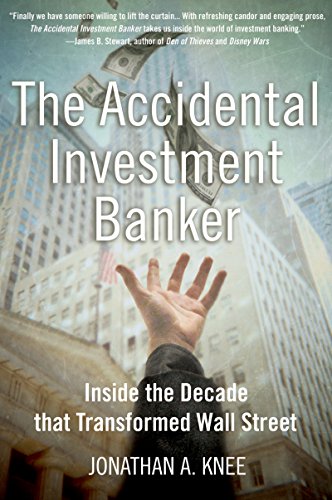
The first of these books was “The Accidental Investment Banker” by Jonathan A. Knee. I chose this book because I had always had my eyes set on Investment Banking, but I wanted to get an inside look on what I would be getting myself into. The book did well in terms of detailing the type of work that an early analyst/associate would do at an Investment Bank as it provided accounts of Knee’s experience building pitch books, going on roadshows, and building client relationships.

Knee also provides his input on the changes he sees developing within the Investment Banking Industry. He uses the legendary Goldman Sachs banker, Sydney Weinberg, as the archetypal relationship-focused Investment Banker; the benchmark for what he feels bankers should strive to become. He laments however that the industry has become more focused on the transactional nature of the business as opposed to being built on nurturing corporate relationships and building one’s reputation as a trusted, go-to adviser. The phrase “I’ll be gone, you’ll be gone” is the short-term mentality that Knee claims has become the standard for how some bankers view the transactions they work on. There is a hopeful tone as the book progresses that the spirit and values of Sidney Weinberg are still what inspires people to get into Investment Banking.

His perspective from having been a senior banker at Goldman Sachs in the 90’s gives readers a behind-the-scenes look into the historic IPO of the bank along with the struggles of maintaining the partnership structure that is so crucial to the culture of Goldman Sachs.

For anyone interested in Investment Banking, or just Wall Street in general, “The Accidental investment Banker” is a must read. Being that it is written based off of Knee’s own experiences, it offers a raw glimpse into the daily work and interactions that define life in the Investment Banking Division. Personally, it was a book that got me excited to continue pursuing my career ambitions now that I had a much stronger idea of what Investment Banking actually entails.

-S.F

Stock/Options Calculator


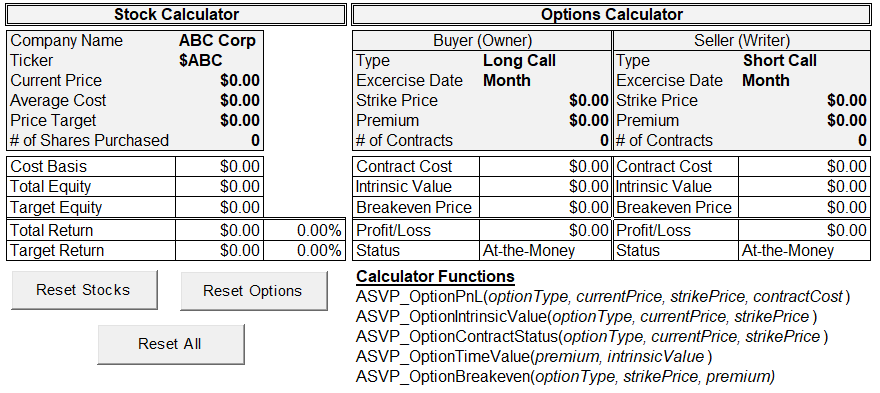
For my first post, I want to share a project I have been working on and am continually working to improve. It is a basic calculator for valuing stock/option positions. Currently, the program is able to calculate Cost Basis, Total Equity, Total Return ($/%), and Targeted Numbers. On the options side of things, it can calculate Contract Cost, Intrinsic Value, Break Even, P/L, and the Contract’s Status (In, At, or Out of the Money). The functionality support both buying and selling calls/puts, just change the selected option type in the drop down menu next to “Type”. Although it was initially built only using excel logic, I have begun incorporating VBA functions in order to make the calculator flow much more efficiently. Try it out for yourself and feel free to comment on it until I come up with an improved, more advanced iteration of this project. Enjoy!

-S.F.

Design a site like this with WordPress.com
Get started